Kingmaker withdrawal, KYC and support complaints
Kingmaker Casino Complaints: Withdrawal, Verification and Support Evidence
 Available in AU
Public complaint portals contain Kingmaker cases alleging delayed withdrawals, verification difficulties and repetitive or unhelpful support responses. Several cases shown on AskGamblers and Casino Guru are marked resolved. These complaints help show recurring themes, but each case is still an individual allegation rather than proof that every Kingmaker withdrawal follows the same pattern. The most useful comparison is between the complaint details, Kingmaker’s published three-business-day internal withdrawal-processing rule, its KYC provisions and the outcome recorded by the portal.
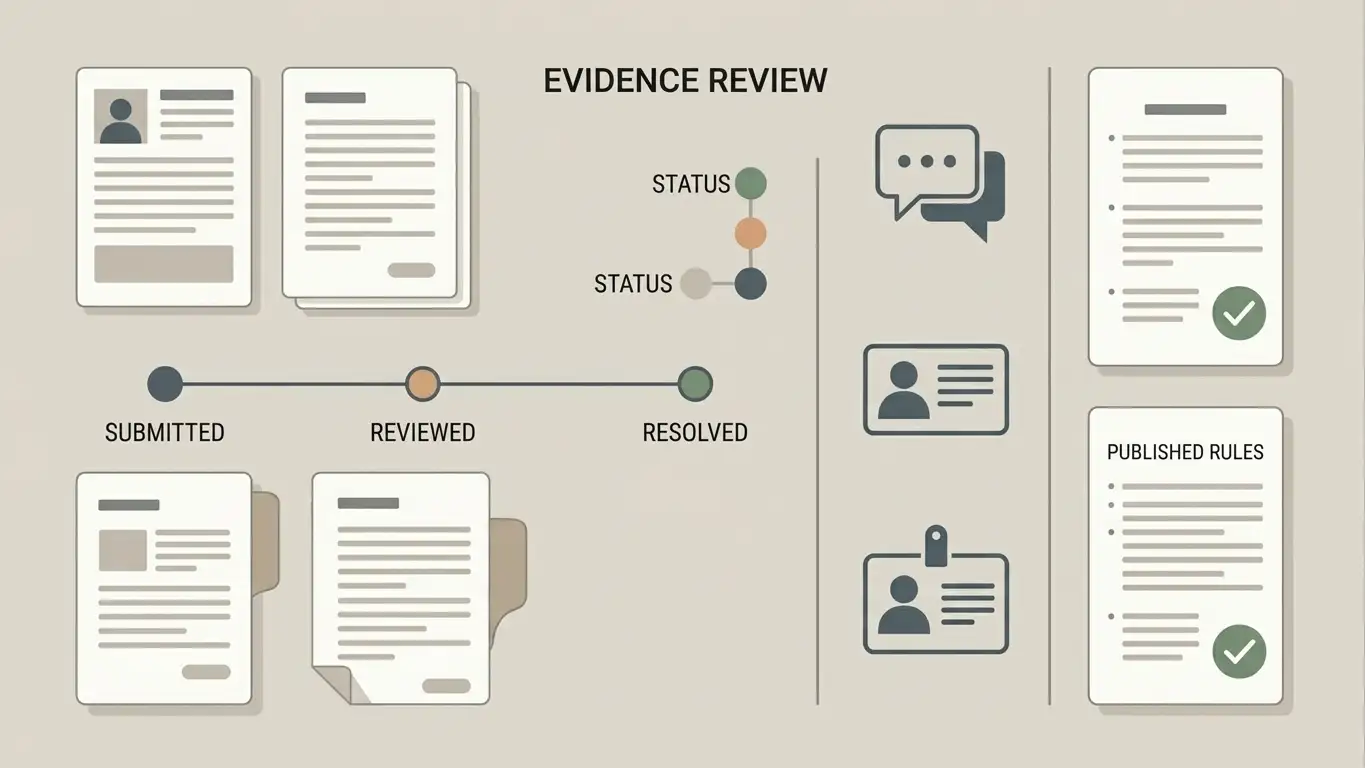
Table of Contents
- What a complaint record can tell you
- Complaint cases show withdrawal and verification themes
- Kingmaker’s three-business-day rule is a benchmark, not an arrival guarantee
- Verification complaints need to be read against the published KYC process
- Support complaints describe communication quality, not necessarily the transaction cause
- Resolved status matters, but it does not erase the original complaint
- Complaints and ACMA enforcement cover different issues
- Kingmaker complaint records on AskGamblers and Casino Guru
- How Kingmaker complaints compare with its withdrawal and KYC rules
What a complaint record can tell you
Complaint pages usually combine a player’s account of what happened, supporting material, replies from the casino or portal and a final case status. These elements should be considered separately because they do not all carry the same meaning.
| Part of the record | What it shows | What it does not prove |
|---|---|---|
| Complaint exists | A public case was filed on a named portal | That the allegation is automatically proven |
| Complainant allegation | The player says a withdrawal, KYC check or support exchange happened in a particular way | That every customer has the same experience |
| Portal outcome | The portal marks the case resolved, unresolved, rejected or another stated status | That the status proves a universal reputation score for the operator |
Kingmaker complaint pages include both serious allegations and cases that were later marked resolved. The key questions are what the player reported, which of the operator’s published rules may apply and how the portal recorded the outcome.
Complaint cases show withdrawal and verification themes
AskGamblers lists multiple Kingmaker withdrawal cases. One case concerns a ZAR 974 withdrawal that the complainant said remained pending beyond the three-business-day period cited from Kingmaker’s terms; the complainant also criticised generic support responses. The portal marks that complaint resolved.
Another AskGamblers case alleges that an initial withdrawal was cancelled and a replacement bank-transfer request remained unprocessed while the player received limited explanations from support. That case is also marked resolved. These records show that delayed-withdrawal complaints exist, but they do not independently prove the reason for each delay.
Casino Guru provides another source of complaint records. One case concerns a EUR 500 withdrawal that the player said was pending verification and was later marked resolved by the portal. Another case describes a longer-running withdrawal dispute involving document exchanges and verification before the portal ultimately marked it resolved.
Together, the two portals show recurring complaints about withdrawals, KYC and support communication. At the same time, the resolved statuses show why a complaint headline should not be treated as the final outcome of a case.
Kingmaker’s three-business-day rule is a benchmark, not an arrival guarantee
Kingmaker’s terms state that its financial department processes withdrawal requests within three business days. The detailed withdrawal terms page explains why this refers to internal processing rather than a guaranteed time for funds to arrive in an external bank account, card or wallet.
That rule is still useful when reading complaints. If a complainant says a request remained pending beyond the stated internal period, the case can be compared with the operator’s published benchmark. The comparison does not establish why the request was delayed. An open KYC review, payment-method issue, transaction check or another condition may affect the individual case.
A complaint can establish that a player reported a delay beyond the stated period and that the portal recorded a particular outcome. It does not establish, without further information, whether the cause was intentional, negligent or fraudulent.
Verification complaints need to be read against the published KYC process
Kingmaker’s terms allow identity and transaction checks and list categories such as certified identification, proof of residence, payment-method ownership and transaction histories where requested. They also state that verification is usually completed within 10 days after a complete reply, while allowing longer or additional checks in some cases.
The dedicated KYC rules page explains that the terms list document categories that may be requested rather than one fixed checklist for every player. A complaint about an extended verification process therefore describes that particular account and does not show that all customers receive the same checks.
When reading a verification complaint, it helps to know whether documents were requested, whether the player says the response was complete, whether more information was later requested and how the portal recorded the outcome. Without those details, a headline such as “withdrawal delayed by verification” may hide a much more complicated sequence of events.
Support complaints describe communication quality, not necessarily the transaction cause
Kingmaker advertises 24/7 live chat and lists [email protected] as a support email. Complaint cases nevertheless include user allegations that support responses were repetitive, vague or did not explain a delay to the complainant’s satisfaction.
Those are meaningful service-quality allegations, but they should be kept separate from the underlying financial question. A support agent giving a generic answer does not by itself prove why a withdrawal is pending, just as a quick response does not prove that every transaction has been correctly processed.
A clear complaint record is easier to understand when it shows the sequence of events: the withdrawal request, any KYC request, documents supplied, support contacts, status changes and the final payment or portal outcome. That sequence is more useful than relying on emotionally charged labels alone.
Resolved status matters, but it does not erase the original complaint
A resolved portal status can mean the disputed payment was completed, the player accepted the outcome, communication improved, or the portal considered the issue settled under its process. The exact reason should be taken from the specific case rather than assumed.
A resolved status does not make the original complaint irrelevant. A delayed payment that is eventually completed can still show how the user experienced the process and what communication problems were reported. The most accurate description is that the case was filed with specific allegations and was later marked resolved.
This is especially important when comparing complaint portals. AskGamblers and Casino Guru use their own moderation and status systems, so a label on one site should not be treated as a universal industry ruling.
Complaints and ACMA enforcement cover different issues
ACMA’s records concern the provider’s supply of prohibited and unlicensed services to Australian customers and website blocking. They do not decide whether a particular withdrawal complaint from another country was handled correctly.
For the Australian regulatory position, see Kingmaker trust and legal status and the specific ACMA blocking record. Individual complaints should be read alongside the case record and the operator terms relevant to the disputed process.
Keeping these issues separate avoids treating a resolved complaint as a reason to dismiss regulatory findings or treating regulatory action as proof of every private transaction dispute.
Kingmaker complaint records on AskGamblers and Casino Guru
The AskGamblers Kingmaker complaints page shows withdrawal-related cases and their displayed resolution status. Casino Guru also has Kingmaker complaint records, including a withdrawal case marked resolved and other cases involving withdrawal and verification difficulties.
These sources show recurring complaint themes and individual case outcomes. They do not support a site-wide claim that Kingmaker always delays withdrawals, always requests a particular KYC document or follows a universal non-payment pattern.
For a broader view of the service, the Kingmaker review covers bonuses, games, payments, mobile access and regulatory information separately from complaint records.
How Kingmaker complaints compare with its withdrawal and KYC rules
Kingmaker complaint records appear on more than one independent portal, with recurring allegations involving withdrawal delays, verification and support communication. Several cases are also marked resolved, so the complaint record does not point to one universal outcome. Kingmaker’s published three-business-day processing rule and KYC provisions provide useful reference points, but the cause of a particular delay cannot be determined without the details of that account. For Australian readers, complaint records should also be considered separately from ACMA enforcement.
Written by the editors at Kingmaker Casino.